Admission Enquiry

Skip to main content
search
Tag

BCA Course in Bangalore

Artificial Intelligence (AI) is the buzzword. Just as human actions are evaluated against a set of standards, a machine that simulates human intelligence must also undergo the same, but stricter, quality check. Modern AI systems excel in many areas, but one area that is often overlooked is ethics.

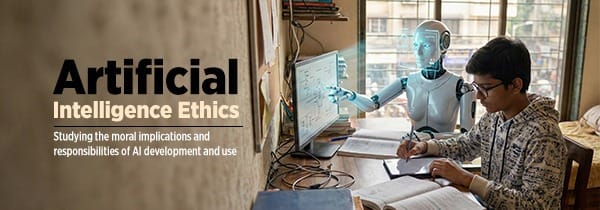
Artificial Intelligence Ethics: Studying the moral implications and responsibilities of AI development and use

By AI, Software, Technology

Artificial Intelligence (AI) is the buzzword. Just as human actions are evaluated against a set of standards, a machine that simulates human intelligence must also undergo the same, but stricter, quality check. Modern AI systems excel in many areas, but one area that is often overlooked is ethics.

Ethics is a system of moral principles that includes ideas about right and wrong, and how people should (or should not) behave in general and specific cases. Why should a machine be ethical? Let’s look at some interesting stories where it wasn’t:

  1. “Ghiblification” (2025) – It was an unconsented training on the copyrighted art; it was a contradiction of Hayao Miyazaki’s philosophy, where he has described art generated by AI as an insult to the human race.
  2. Amazon’s Biased Hiring Tool (2014/2018): Amazon had to scrap an AI recruiting tool that taught itself to prefer male candidates, as it was trained on resumes submitted to the company over 10 years, most of which came from men.

These examples explain why ethics are important for AI. Let’s explore the moral implications of AI:

  • Biased AI: AI systems can inherit human biases from their training data, which can lead to wrong interpretations and results.
  • AI in law: AI-based decisions may lack transparency, neutrality, and accountability, potentially resulting in discrimination.
  • Privacy Concerns: AI uses a huge amount of data to train, and most of it is personal, high-security data.
  • Accountability: When AI makes a wrong move, who is responsible – the developer or AI?
  • Job and Economic Impact: AI-driven automation can widen economic inequality by replacing human jobs with machines.

Given these concerns, we know why AI must be ethical and why it is a serious concern; several government and non-government organizations have proposed frameworks and guidelines.

  1. The European Union (EU) Artificial Intelligence Act is a landmark regulation that sets standards for how AI systems must be developed, deployed, and used across all EU member states.
  2. UNESCO’s Global Recommendation on the Ethics of AI, which encourages multi-stakeholders’ involvement to come up with rules and regulations.
  3. OECD’s AI principles, which focus on human – centred values and fairness, transparency, and explainability
  4. IEEE Global Initiative on Ethics of Autonomous and Intelligent Systems -Technical standards and ethical frameworks for AI developers.

In conclusion, efforts have been made to make AI ethical and responsible, and they must continue proactively. As the saying goes, “Prevention is better than cure.” Establishing strong ethical standards for AI is not optional—it is necessary to ensure technology benefits humanity without causing harm.

Agent AI is a smart system that focuses on many environments in today's life, taking complex tasks and relearning trends, managing the actions of the daily to-do list using various smart devices.

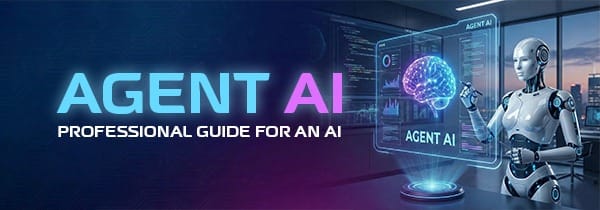
AGENT AI: Professional Guide for an AI

By Technology

Agent AI is a smart system that focuses on many environments in today’s life, taking complex tasks and relearning trends, managing the actions of the daily to-do list using various smart devices. It often uses LLMs: Large Language Models as a working brain for the agents, which break down the tasks with certain tools like web search and code execution, and adapt over time beyond chatbot intelligence with digital assistants, improving the functionality.

AI workflows make it more reliable for understanding the LLMs to execute the user prompts with the help of their knowledge, and also a few technical persons work with prompt engineering to generate solutions for their work environment, for example: ChatGPT, Claude AI, Gemini 3.5, etc. these works similar to programming concepts Inputà Processing → Output. As it comes to AI Agents it is Input → LLM → Output.

Key Relevance to LLMs:

  • LLMs have to train with large amounts of data, where they basically focus on replying to the prompts of entries taken either in keywords, text, or audio (voice) mechanisms.
  • Despite large amounts of data, it usually cannot override the privacy management of personal data and has some limitations on proprietary information.
  • It is passive because it will focus on the reason typed by the user, and it waits for the specific entry to be made by the individual and then reacts to it.
  • Now it’s more buzzing with text to audio interface or audio to text interface with LLMs implemented in AI agents to work with many apps like Calendar, Google Sheets, and much more.
  • Helena Liu is one of the AI workflow tools that can use various AI tools, like Perplexity, to summarize a link or web search content.
  • Composing the routing mechanisms to enhance posts in professional and social media automatically using Claude AI.
  • We can schedule the post on both the accounts professional and social with the time frame bundled into an operation using an AI workflow.

Why AI agents?

  • AI Agents are the tools that choose a reason via AI and the tools to compile links, summarize articles, and write posts on the platforms required to be posted.
  • It uses something called the ReAct Framework = Reasoning +Act we also call ReAct.
  • It doesn’t end here; it must be an iterative mechanism. Where human and AI interaction must be iteratively working on it.
  • But we can also simplify using Critique Bot, which is placed in the place of a human, and it also follows the same process.
  • Vision Agent works on reasoning where it formulates the process and displays the results.
  • AI agents are the tools that chose a reason via AI tools to compile links, summarize articles and write posts on the platforms required to be posted.
  • It uses something called ReAct Framework = Reasoning + Act we also call ReAct.
  • It doesn’t end here; it must be an iterative mechanism where Human and AI interaction must be iteratively working on it.
  • But we can also simplify by using Critique Bot, which is placed in the place of a human and also follows the same process.
  • Vision Agent works on reasoning, where it formulates the process and displays the results.

Conclusion

AI agents work with a bundle of operations using LLM tools and techniques. interactive mechanisms with the ReAct framework, which uses AI tools to create professional content to make your post trendy and your profile grow at a massive rate, and even uses social media posts with an AI workflow, which are eye-catching platforms for individuals to grow their profiles. As we see many tools. But there will always be an improvised version of tools in the future days.

Today, we are living in a time where technology has become a natural part of our daily lives. By 2025, Machine Learning (ML) is no longer just a popular term or experimental idea. It is now working silently in the background of many systems we use every day. It helps doctors notice health problems early, supports companies in managing supply chains, and assists decision-making even before problems appear.

The Evolving Role of Technology in Our Lives

By Technology

Today, we are living in a time where technology has become a natural part of our daily lives. By 2025, Machine Learning (ML) is no longer just a popular term or experimental idea. It is now working silently in the background of many systems we use every day. It helps doctors notice health problems early, supports companies in managing supply chains, and assists decision-making even before problems appear.

At its core, Machine Learning has changed how computers work with humans. Earlier, computers needed exact instructions for every small task. Now, instead of giving step-by-step commands, we allow machines to learn from examples, similar to how humans learn from experience.

From Fixed Instructions to Learning from Data

In the past, software programs depended completely on rules written by humans. If we wanted a computer to recognize a cat, we had to describe everything in detail—ears, eyes, shape, and size. This method was slow and failed easily if the image looked slightly different.

Machine Learning introduced a smarter approach. Instead of defining rules, we show the system many examples. The computer studies these examples and finds patterns on its own. It does not memorize instructions; it learns how likely something is to be true. This is like the difference between memorizing answers and actually understanding a topic.

Different types Machines Learning

Machines can learn in different ways, depending on the problem they need to solve:

Supervised Learning

In this method, the machine learns using data that already has correct answers. It is similar to a student practicing with solved questions. This approach is commonly used in face recognition, email spam detection, and medical image analysis.

Unsupervised Learning

Here, the machine is given data without any labels. It tries to find patterns or groups by itself. Banks use this method to detect unusual spending behavior, which may indicate fraud.

Reinforcement Learning

This learning style is based on trial and error. The system performs actions and receives rewards for correct actions and penalties for wrong ones. Over time, it learns the best way to reach its goal. This approach is used in self-driving cars, robotics, and game-playing AI.

Understanding Deep Learning

Deep Learning is a part of Machine Learning inspired by how the human brain works. It uses multiple layers called neural networks.

The first layers detect simple things like lines and edges. The middle layers understand shapes and textures. The final layers combine everything to recognize complex information such as objects or meaning. Because of this layered structure, deep learning models can understand context instead of just numbers.

The Effort Behind Smart Systems

Although Machine Learning appears impressive, most of the work happens behind the scenes. A large amount of time is spent preparing and cleaning data. If the data is incorrect or biased, the results will also be unreliable.

Another challenge is overfitting, where the model performs very well on training data but fails when it sees new data. Engineers carefully design models to avoid this problem so that systems work well in real-world situations.

Transparency and Ethical Concerns

As Machine Learning models become more complex, it becomes harder to understand how they make decisions. This is known as the black box problem. In important fields like healthcare or law, decisions must be explained clearly.

To address this, researchers are developing Explainable AI, which helps humans understand why a model made a particular decision. There is also concern about bias, since machines learn from human-created data and may inherit unfair patterns. Ensuring fairness and responsibility is an important part of modern AI research.

Conclusion: Humans and Machines Working Together

Machine Learning is moving toward systems that can handle a wide range of tasks instead of only one specific job. Rather than replacing humans, these systems are designed to support us.

The real goal of Machine Learning is partnership. Machines handle complex data and patterns, while humans focus on creativity, values, and decision-making. Together, this collaboration can lead to better solutions and a smarter future.

Close Menu
Privacy Overview

The ST PAULS COLLEGE Website uses cookies so that we can provide you with the best user experience possible. Cookie information is stored in your browser and performs functions such as recognising you when you return to our website and helping our team to understand which sections of the website you find most interesting and useful.

Read more about our Privacy Policy here