Admission Enquiry

Skip to main content
search
Tag

Best UG College In Bangalore

Organisations often mistake silence for professionalism. The employee who nods along is labelled "collaborative," while the one who questions decisions is labelled "difficult." This might feel productive in the moment, but it's quietly dismantling your company from within.

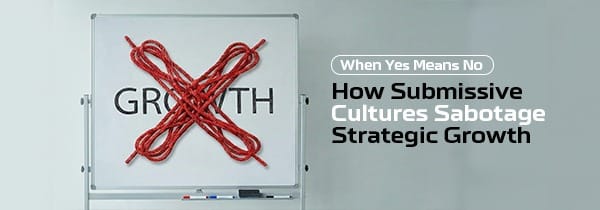
When Yes Means No: How Submissive Cultures Sabotage Strategic Growth

By General

Organizations often mistake silence for professionalism. The employee who nods along is labelled “collaborative,” while the one who questions decisions is labelled “difficult.” This might feel productive in the moment, but it’s quietly dismantling your company from within.

Every failed product launch, every missed opportunity, every strategic misstep—someone saw it coming. They just chose silence over confrontation because speaking up has consequences. When dissent is punished and compliance is rewarded, you don’t build strong teams. You build echo chambers where bad ideas flourish unchallenged.

Consider what happens during a typical meeting. Someone raises a concern about an unrealistic timeline. Leadership responds defensively. The room goes quiet. Everyone learns the real lesson: keeping your head down is safer than being right. Six months later, the project fails spectacularly, and management wonders why nobody warned them.

They did. But warning and being heard are entirely different things.

The strongest organizations don’t avoid disagreement—they cultivate it strategically. They understand that the person making them uncomfortable today might save them from disaster tomorrow. Real leaders don’t surround themselves with people who agree. They seek out the voices most likely to challenge their assumptions, because they know their own perspective is incomplete.

Growth lives outside comfort zones. When meetings run too smoothly, and plans face zero pushback, that’s not alignment—it’s stagnation wearing a professional mask.

The question isn’t whether your organization has problems. The question is whether people who see those problems feel safe enough to speak up and whether leadership is brave enough to listen. Because silence isn’t harmony. It’s just a catastrophe waiting to happen.

When Market Dominance Breeds Complacency: Management Lessons from IndiGo’s Crisis

IndiGo’s recent operational meltdown offers a masterclass in how market dominance can blind management to fundamental planning failures. India’s largest airline, controlling 65 percent of the market share, cancelled thousands of flights in December 2025, stranding passengers during peak wedding season and exposing a troubling pattern: success breeding dangerous complacency.

The root cause wasn’t external disruption or unforeseen circumstances. New flight duty regulations were announced in January 2024, with airlines given months to adapt. Competitors like Air India and SpiceJet managed the transition smoothly. IndiGo didn’t. The airline admitted the crisis stemmed from planning gaps and crew mismanagement—failures entirely within management’s control.

This reveals a critical management principle: when you dominate a market, the greatest threat isn’t competition—it’s your own overconfidence. IndiGo had built its reputation on punctuality and operational excellence. Yet when regulatory changes demanded adaptation, management apparently believed its size insulated it from consequences.

The planning failure was staggering. IndiGo had approved a 6% increase in departures for winter despite knowing new duty limitations would reduce pilot availability. They expanded capacity while their workforce shrank. Basic arithmetic should have prevented this disaster, yet management pressed forward regardless.

What makes this particularly instructive is the response. Rather than accept accountability immediately, the airline initially downplayed the severity. Only after government intervention and public outcry did leadership acknowledge the crisis fully. This delayed response compounded the operational failure with a reputational one.

The lesson transcends aviation: market leadership demands heightened vigilance, not relaxed standards. Success creates blind spots. Dominance breeds assumptions that rules apply differently to you. And when that mindset takes root in management, even straightforward regulatory compliance becomes a crisis.

IndiGo’s operational excellence was built over the years. Their planning failure destroyed trust in days. That’s the real cost of complacency.

Work-Life Balance Gets Legal: Understanding India’s Right to Disconnect Proposal

What exactly is this bill everyone’s talking about?

The Right to Disconnect Bill 2025 was introduced in the Lok Sabha by NCP MP Supriya Sule on December 5th. Basically, it wants to give employees legal protection to ignore work calls, emails, and messages once they’re off work without getting into trouble for it.

So, can I just switch off my phone after work hours?

That’s the idea. The bill says you shouldn’t face disciplinary action for refusing to respond to work stuff outside office hours, on weekends, or on holidays. Think of it as putting a legal boundary around your personal time. It suggests creating an Employees’ Welfare Authority to enforce these rules and even proposes counselling services and digital detox centers to help people deal with work stress. For companies with more than ten employees, there would be proper negotiations about overtime and after-hours work.

Has the Parliament actually passed this law?

No, not yet. Here’s where it gets interesting. This is what’s called a Private Member’s Bill, which means it was introduced by an MP who isn’t a minister. These bills rarely become actual laws. In fact, Sule tried introducing similar bills twice before, in 2018 and 2021, and both times they didn’t make it through.

How does this matter then?

Because it started a conversation India desperately needs. A 2024 report showed 70% of Indian employees check work messages after hours, and burnout cases keep rising. Remember the tragic case of the young chartered accountant who died allegedly from work stress? That really pushed this issue into the spotlight.

Are other countries doing this?

Yes! France, Portugal, and Australia already have similar laws protecting employees’ right to disconnect. They’ve recognized that constant connectivity isn’t just exhausting—it’s harmful.

Whether this bill becomes law or not, one thing’s clear: we’re finally questioning whether being available 24/7 should be the norm, and India could finally give legal permission to ignore them.

Top degree colleges in Bangalore

ECOCRITICISM: STUDYING LITERATURE THROUGH THE LENS OF ENVIRONMENTAL CONCERNS

By General

Ecocriticism is the study of literature and ecology from an interdisciplinary point of view that explores the relationship between humans and the physical environment through literature and other cultural forms. Here, literary scholars analyze texts that illustrate environmental concerns and examine the various ways literature treats the subject of nature. Emerging in the 1990s, this field links together literature and ecology in an inquiry into how storytelling forms our views of the natural world and of its most significant environmental concerns. Ecocriticism, as a movement, began with the publication of Rachel Carson’s ‘Silent Spring’ in 1962, where it investigated and criticized the use of pesticides in farming and the ways in which they can inherently damage the environment. Analyzing texts through an environmental lens makes ecocriticism urge readers to consider how narratives reflect, influence, and shape cultural attitudes towards nature.

The term ‘Literary Ecology’ was first coined by Joseph Meeker in his book ‘The Comedy of Survival,’ published in 1972, while the term ‘ecocriticism’ was first used by William Rueckert in his essay, ‘Literature and Ecology: An Experiment in Ecocriticism,’ in 1978.

By challenging the classical anthropocentric view of things, ecocriticism questions human-centric views that dominate literature. It emphasizes the correlation of all life forms, inviting readers to reconsider the value and agency of non-human entities and also address ecological challenges such as climate change, deforestation, and species extinction by questioning human responsibility towards nature. In today’s world, where environmental crises are becoming increasingly critical, ecocriticism plays a vital role in advocating environmental awareness and encouraging sustainable practices. Engaging with literature through this lens is not just a means of exploring creative expressions but also an urge to reflect on the real-world environmental issues that shape our lives. In the final analysis, ecocriticism serves as a device for both understanding literature and fostering a deeper, more ethical relationship with the environment.

BBA Degree Colleges in Bangalore

Tough Markets? Here’s how to invest

By General

Investing in uncertain markets is risky, but experts say there is an opportunity to make a profit. Due to the event of the market, the price indicates an instability.  A good investment strategy can help you reduce risks and make great returns during such times. 

Having different types of investments plays an important role in a volatile market.  By investing in several asset classes, like stocks, bonds, real estate, and commodities, investors reduce the shocks of any stock market crash or one sector going bad. When a portfolio is well-diversified, it makes them less vulnerable to shocks.

Distribution Center Automation (DCA) is another effective strategy. This tactic is when you invest a fixed amount of money at regular intervals regardless of the market’s condition. DCAs are a good way to avoid mistiming the markets. They help you benefit when prices are low during downtrends. They smoothen out times.

For example, blue-chip stocks often show strength when other stocks crash and pay out dividends making sure returns are consistent.

Hedging strategies can offer portfolios more protection. Using instruments like options, futures, or inverse ETFs can lessen potential losses for holding an asset during a bad time. Moreover, it is good to keep some investments like cash and money market funds handy so that you can seize any opportunity that arises.

one smart strategy is to invest in sectors that defend the market, like healthcare, utilities, and consumer staples. Sectors showing less volatility attach themselves to good and service demand prevailing in any conditions including adverse ones.

Always keep yourself updated and make long-term investments. The feelings of a volatile equity market often make investors act hastily, which will hurt the portfolio. A disciplined investment approach, informed by research and professional advice, helps investors stay focused on their goals. 

Finally, markets are very turbulent when growing or declining but plenty of opportunities are available to ipad. Investors can weather uncertainty through the certainty and resilience of diversification, dollar-cost averaging, and high-quality funds. Patience and self-discipline are the keys to success in these uncertain times.

6 Trends that BBA Graduates Should Track in 2023!

By Uncategorized

The Job market has witnessed a massive surge in competition and turbulence among candidates over the last two years. Thanks to the pandemic, the condition isn’tisn’t likely to be tranquil in 2023.

Since the job market is volatile, it becomes necessary for a candidate to stay on top of all the changing trends and updates. On the other hand, in 2022, the market saw exponential growth in openings than there were candidates. Similarly, in 2023 we can expect to witness a rise in job listings as organizations across the Globe try to expand and build back from the pandemic.

We’ve identified some top trends you should expect to see in the BBA industry in 2023 and explained why these trends would be game-changing. In this article, you’ll find all the latest information you need to keep yourself updated in the field of BBA in 2023.

Business Administration has been a popular choice for many students aspiring to pursue business and positions at top organizations. The course has seen a steep 15% rise in the past few years. Since many students are opting for a degree in BBA rather than engineering and medicine. The reason for this development is the diverse disciplines of the BBA course. This article attempts to explain some of Bangalore’s BBA course trending disciplines.

  •    BBA Business Analytics

BBA Business Analytics provides students with a deep comprehension of business and management strategies that implies methodical and strategic analysis of the data that drive towards achieving financial goals for the company. All the aspiring students will have a firm hold of emerging data analytics trends across the Globe.

In this particular degree, students will study topics such as Data Analysis, Data Mining, Lead Management, and Revenue Generation. IT giants like Accenture, Infosys, Capgemini, Wipro, TCS, Adobe etc., largely hire students with a BBA in Business Analytics students in Bangalore.

  •    BBA Finance and Accountancy 

BBA Finance and Accountancy still spur more demand in the job market, another popular choice for many desiring positions in Banks and FMCGs. This course focuses on subjects associated with finance and accounting management. Finance and accounting are important characteristics of any business or organization. Only qualified professionals can handle such important aspects.

Many organizations employ a large number of students with skills related to finance and accounting. Banks, FMCGs, Service-based companies, and consumer goods companies are the ones hiring Finance and accountancy professionals.

  •    BBA Travel and Tourism

The travel and tourism industry has witnessed a drastic surge during the past few decades bringing a larger scope for BBA degree holders. More and more people travelling worldwide have increased the demand for tour operators and related industries across the Globe. Tourism is among the most rewarding and active economic sectors for many countries, including India. BBA Travel and Tourism graduates are primarily hired by companies such as Thomas Cook, Cox & Kings, Emirates, Air India, Trivago, Make My Trip and many more.

  •    BBA Global

BBA Global students learn the techniques and concepts of international trade and finance

Students will acquire in-depth knowledge of exchanging goods and services, capital and services required for international trade and markets. A BBA Global degree will take you and your career to greater heights, especially for those students aspiring to work abroad and in other countries. BBA Global students have many employment opportunities in the industry. They are mainly employed by leading multinational and large corporations with international trade relationships.

Some areas where BBA students are hired :

  •    BBA in Information Technology

The BBA in Information Technology is a comprehensive degree in the basic and functional fields of information technology and management. In this course, students will learn about new IT sector business trends. Degrees include the IT curriculum for computer science, information database management, networking information technology, information management theory, and related technology applications. Companies such as United Airlines, Tech Mahindra, Infosys, Google, and Microsoft constantly post positions for BBA IT Graduates.

  •    BBA in Human Resource

The BBA in HR course is still a main course in the industry; the Human Resource Management BBA is one of the most popular UG management courses. This course combines common management practices with expert training in human resource management. Human resources are among the most respected departments because they play an important role in developing a company’s corporate policy. Major startups and companies across the Globe often hire BBA HR graduates.

Students in a business administration bachelor’s curriculum learn how to offer managerial solutions for ongoing organisational problems. Students will investigate how effective management and conventional marketing can improve a company’s performance. They learn about company procedures and practises in addition to being fully informed about current market changes. We’re the Best BBA College in Bangalore, India ,our vision is to provide academic excellence and value-based education to create professionals for a better tomorrow.

Close Menu
Privacy Overview

The ST PAULS COLLEGE Website uses cookies so that we can provide you with the best user experience possible. Cookie information is stored in your browser and performs functions such as recognising you when you return to our website and helping our team to understand which sections of the website you find most interesting and useful.

Read more about our Privacy Policy here