Admission Enquiry

Skip to main content
search
Category

AI

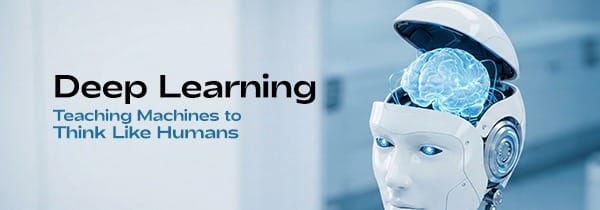
Deep learning is a part of artificial intelligence that allows computers to learn from data in a way similar to how humans learn from experience. Instead of giving the computer fixed rules, we provide examples and let it learn patterns on its own.

Deep Learning: Teaching Machines to Think Like Humans

By AI, Technology

Deep learning is a part of artificial intelligence that allows computers to learn from data in a way similar to how humans learn from experience. Instead of giving the computer fixed rules, we provide examples and let it learn patterns on its own.

In earlier days, computers worked only with rules written by humans. For simple tasks, this worked well. However, for complex tasks like recognizing faces, understanding handwriting, or detecting fake documents, writing rules is very difficult. Deep learning helps solve these problems by learning directly from data.

Deep learning uses neural networks, which are inspired by the human brain. These networks contain layers. The input layer receives data, the hidden layers learn important features, and the output layer gives the final result. When many hidden layers are used, the learning becomes deeper, which is why it is called deep learning.

One major advantage of deep learning is that it automatically learns useful features without human effort. It performs very well when large amounts of data are available and often provides high accuracy compared to traditional methods.

There are different types of deep learning models. Convolutional Neural Networks (CNNs) are mainly used for image-related tasks such as face recognition and medical image analysis. Recurrent Neural Networks (RNNs) are used for text, speech, and time-based data.

Deep learning is already part of our daily life. It is used in smartphones for face unlock, in Google search for auto suggestions, in YouTube and Netflix for recommendations, and in banking systems for fraud detection.

Although deep learning is powerful, it also has limitations. It needs large datasets, strong computing resources, and sometimes its decisions are hard to explain. Therefore, careful and ethical use is important.

In conclusion, deep learning helps computers learn from data and solve complex real-world problems. It plays an important role in modern technology and will continue to shape the future.
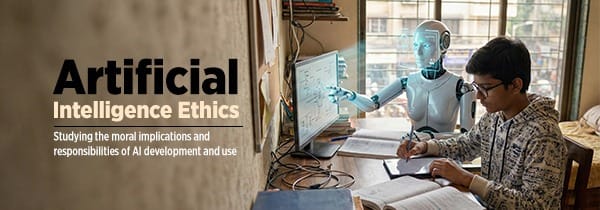

Artificial Intelligence (AI) is the buzzword. Just as human actions are evaluated against a set of standards, a machine that simulates human intelligence must also undergo the same, but stricter, quality check. Modern AI systems excel in many areas, but one area that is often overlooked is ethics.

Artificial Intelligence Ethics: Studying the moral implications and responsibilities of AI development and use

By AI, Software, Technology

Artificial Intelligence (AI) is the buzzword. Just as human actions are evaluated against a set of standards, a machine that simulates human intelligence must also undergo the same, but stricter, quality check. Modern AI systems excel in many areas, but one area that is often overlooked is ethics.

Ethics is a system of moral principles that includes ideas about right and wrong, and how people should (or should not) behave in general and specific cases. Why should a machine be ethical? Let’s look at some interesting stories where it wasn’t:

  1. “Ghiblification” (2025) – It was an unconsented training on the copyrighted art; it was a contradiction of Hayao Miyazaki’s philosophy, where he has described art generated by AI as an insult to the human race.
  2. Amazon’s Biased Hiring Tool (2014/2018): Amazon had to scrap an AI recruiting tool that taught itself to prefer male candidates, as it was trained on resumes submitted to the company over 10 years, most of which came from men.

These examples explain why ethics are important for AI. Let’s explore the moral implications of AI:

  • Biased AI: AI systems can inherit human biases from their training data, which can lead to wrong interpretations and results.
  • AI in law: AI-based decisions may lack transparency, neutrality, and accountability, potentially resulting in discrimination.
  • Privacy Concerns: AI uses a huge amount of data to train, and most of it is personal, high-security data.
  • Accountability: When AI makes a wrong move, who is responsible – the developer or AI?
  • Job and Economic Impact: AI-driven automation can widen economic inequality by replacing human jobs with machines.

Given these concerns, we know why AI must be ethical and why it is a serious concern; several government and non-government organizations have proposed frameworks and guidelines.

  1. The European Union (EU) Artificial Intelligence Act is a landmark regulation that sets standards for how AI systems must be developed, deployed, and used across all EU member states.
  2. UNESCO’s Global Recommendation on the Ethics of AI, which encourages multi-stakeholders’ involvement to come up with rules and regulations.
  3. OECD’s AI principles, which focus on human – centred values and fairness, transparency, and explainability
  4. IEEE Global Initiative on Ethics of Autonomous and Intelligent Systems -Technical standards and ethical frameworks for AI developers.

In conclusion, efforts have been made to make AI ethical and responsible, and they must continue proactively. As the saying goes, “Prevention is better than cure.” Establishing strong ethical standards for AI is not optional—it is necessary to ensure technology benefits humanity without causing harm.

As we move deeper into 2026, the conversation around Artificial Intelligence has shifted from "What can it do?" to "What should it do?" For academic institutions and tech leaders, the challenge isn't just coding efficiency—it's encoding values.

The Shadow in the Code: Formulating AI Ethics vs. Human Morality

By AI, Technology

As we move deeper into 2026, the conversation around Artificial Intelligence has shifted from “What can it do?” to “What should it do?” For academic institutions and tech leaders, the challenge isn’t just coding efficiency—it’s encoding values.

But how do we formulate a “machine conscience”? To do so, we must first understand the fundamental gap between how humans reason and how algorithms process “right” and “wrong.”

  1. The Core Differentiator: Intuition vs. Logic

Human ethics are deeply rooted in biological evolution and social emotion. We feel guilt, empathy, and shame—internal compasses that guide our decisions before we even consciously think about them.

In contrast, AI ethics are mathematically formulated. An AI does not “feel” that a biased loan approval is wrong; it simply optimizes for a mathematical objective function.

  • Human Ethics: Context-dependent, driven by “common sense” and emotional intelligence.
  • AI Ethics: Rule-bound, driven by data parity, statistical fairness, and “if-then” constraints.
  1. Philosophical Frameworks: Translating Kant and Mill into Python

When we build ethical AI frameworks, we are essentially translating centuries of human philosophy into high-dimensional space.

Deontology (Duty-Based Ethics)

The Kantian approach suggests that certain actions are inherently right or wrong, regardless of the outcome. In AI, this translates to Hard Constraints. For example: “An autonomous vehicle must never violate a traffic signal,” even if doing so saves time.

Utilitarianism (Outcome-Based Ethics)

This framework seeks the “greatest good for the greatest number.” Most current AI models are inherently utilitarian—they are designed to minimize a “loss function.” However, a purely utilitarian AI might justify sacrificing the privacy of a few to benefit the many—a major ethical pitfall in data science.

  1. The Formulation Problem: From Principles to Practice

The industry has moved beyond vague manifestos. In 2026, formulating AI ethics requires a three-layer approach:

  1. The Policy Layer: Establishing “Human-in-the-loop” (HITL) requirements where high-stakes decisions (medical, legal, financial) must be verified by a person.
  2. The Technical Layer (Algorithmic Fairness): Implementing “Fairness Constraints” in the training phase to ensure the model doesn’t inherit historical human biases.
  3. The Transparency Layer (Explainable AI): Ensuring the “Black Box” can explain why it made a decision. If a human cannot explain their reasoning, they are held accountable; we must demand the same from our machines.
  4. Why “Original” Ethics Matter for SEO and Leads

In the world of 2026, search engines prioritize E-E-A-T (Experience, Expertise, Authoritativeness, and Trustworthiness). Generic AI-generated content about ethics is everywhere. To win organic leads, our content must feature:

  • Faculty Insights: Unique case studies from our labs.
  • Contrarian Views: Challenging the status quo on AI regulation.
  • Practical Frameworks: Giving potential partners a roadmap they can actually use.

Conclusion: Bridging the Gap

We aren’t just teaching machines to follow rules; we are teaching them to respect human dignity. As our faculty takes their break, the goal is to leave behind a legacy of “Responsible Innovation” that doesn’t just advance technology, but protects the humans who use it.

UG College in Bangalore

Transforming our daily life with AI in India

By AI, Technology

Artificial intelligence (AI) presents revolutionary possibilities to supplement human intelligence and improve our way of life and employment. AI and machine learning are now deeply ingrained in almost every aspect of contemporary technology due to their wide and expanding range of applications.

The Indian government has come up with a plan for AIEL transformation for intelligence that is all about using it in different industries. This plan is going to help change the way artificial intelligence is used in India. India is getting ready to enter a time where artificial intelligence is going to be very important. Artificial intelligence is changing the way people live. It is also affecting how the country is developing. The Indian government wants to use intelligence to make a big difference in people’s lives and in the country as a whole, and this is all part of the artificial intelligence strategy.

Artificial intelligence is not something you find in big companies or science labs anymore. It is everywhere. It affects every single person. For example, artificial intelligence is helping farmers make decisions about what crops to plant. It is also helping people who live in the country get the care they need. Artificial intelligence is making our daily lives easier, more connected, and smarter. Artificial intelligence is really changing the way we live.

The government is making services better by using information to make decisions faster. They are also changing the way kids learn in school by giving each student their special way of learning. The government is making cities safer and cleaner for people to live in, which is good for everyone, especially the people who live in these cities, and the cities themselves are becoming places to be.

The main thing about this change is the programs, like the centers of excellence for Artificial Intelligence and the India Artificial Intelligence mission. These Artificial Intelligence programmes are helping with research, making it easier for people to use computers, and giving a hand to institutions and startups so they can come up with solutions that directly help people.

In order to ensure that innovation benefits society as a whole, India’s strategy focuses on making AI open, accessible, and affordable. However, artificial intelligence (AI) is the capacity of machines to carry out tasks that typically call for human intelligence. It makes it possible for systems to learn from mistakes, adjust to novel circumstances, and resolve challenging issues on their own.

AI analyzes data, finds patterns, and produces answers using datasets, algorithms, and large language models. With time, these systems become more capable of reasoning, making decisions, and communicating in ways that are comparable to those of humans.

Artificial intelligence is really changing our lives. It is changing a lot of things. For example, the way we take care of our health, the way we grow food, the way we learn things, the way we govern our country, and the way we predict the weather.

Artificial intelligence is helping students learn better. It is helping doctors find out what is wrong with patients faster. Artificial intelligence is also helping farmers make decisions about their farms.

Artificial intelligence is making our government work better. It is making our government more open. Artificial intelligence is doing a lot of things for us.

India’s plan for intelligence is not just about the technology; it is also about making sure everyone benefits from it. India wants to make sure people have the power to use intelligence through programs in the country, and by working with other countries. Artificial intelligence is a part of this plan, and India is using artificial intelligence to achieve its goals. AI is being used to improve public services, solve real-world problems, and increase opportunities for all citizens.

Close Menu
Privacy Overview

The ST PAULS COLLEGE Website uses cookies so that we can provide you with the best user experience possible. Cookie information is stored in your browser and performs functions such as recognising you when you return to our website and helping our team to understand which sections of the website you find most interesting and useful.

Read more about our Privacy Policy here