Admission Enquiry

Skip to main content
search
Tag

Best Degree College in Bangalore

Deep learning is a part of artificial intelligence that allows computers to learn from data in a way similar to how humans learn from experience. Instead of giving the computer fixed rules, we provide examples and let it learn patterns on its own.

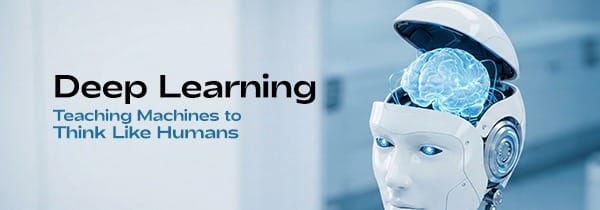
Deep Learning: Teaching Machines to Think Like Humans

By AI, Technology

Deep learning is a part of artificial intelligence that allows computers to learn from data in a way similar to how humans learn from experience. Instead of giving the computer fixed rules, we provide examples and let it learn patterns on its own.

In earlier days, computers worked only with rules written by humans. For simple tasks, this worked well. However, for complex tasks like recognizing faces, understanding handwriting, or detecting fake documents, writing rules is very difficult. Deep learning helps solve these problems by learning directly from data.

Deep learning uses neural networks, which are inspired by the human brain. These networks contain layers. The input layer receives data, the hidden layers learn important features, and the output layer gives the final result. When many hidden layers are used, the learning becomes deeper, which is why it is called deep learning.

One major advantage of deep learning is that it automatically learns useful features without human effort. It performs very well when large amounts of data are available and often provides high accuracy compared to traditional methods.

There are different types of deep learning models. Convolutional Neural Networks (CNNs) are mainly used for image-related tasks such as face recognition and medical image analysis. Recurrent Neural Networks (RNNs) are used for text, speech, and time-based data.

Deep learning is already part of our daily life. It is used in smartphones for face unlock, in Google search for auto suggestions, in YouTube and Netflix for recommendations, and in banking systems for fraud detection.

Although deep learning is powerful, it also has limitations. It needs large datasets, strong computing resources, and sometimes its decisions are hard to explain. Therefore, careful and ethical use is important.

In conclusion, deep learning helps computers learn from data and solve complex real-world problems. It plays an important role in modern technology and will continue to shape the future.

SEO helps people find your website naturally on search engines. By tracking simple SEO metrics, you can understand what works, improve your content, and grow your online presence over time. SEO is a long-term effort, but when done right, it delivers lasting benefits.

SEARCH ENGINE OPTIMIZATION: A KEY ROLE ON SEARCH METRICS

By General

Search Engine Optimization (SEO) is the practice of improving a website so it appears higher on search engines like Google. When people search for information, products, or services online, SEO helps your website show up in those search results. The higher your website appears, the more likely people are to visit it.

In simple terms, SEO helps your website get free and relevant traffic from search engines.

SEO focuses on three main areas:

  • Content SEO: Creating useful, clear, and relevant content that answers users’ questions.
  • Technical SEO: Making sure the website loads fast, works well on mobile devices, and is easy for search engines to understand.
  • Link Building: Getting other trusted websites to link to your site, which builds credibility.

When these work together, search engines trust your website more and rank it higher.

Why SEO Metrics Are Important

SEO metrics help you understand whether your efforts are working. They show how people find your website, how they behave on it, and whether your goals are being achieved.

Without tracking metrics, it is difficult to know what needs improvement.

Key SEO Metrics Explained Simply

  1. Organic Traffic

This shows how many people visit your website through search engines without paid ads. More organic traffic usually means better SEO.

  1. Keyword Rankings

This tells you where your website appears in search results for specific words or phrases. Higher rankings bring more visibility.

  1. Click-Through Rate (CTR)

CTR shows how many people click your website after seeing it in search results. A good title and description can improve this.

  1. Bounce Rate

This measures how many visitors leave after viewing just one page. A high bounce rate may mean the content is not meeting expectations.

  1. Time Spent on Page

If visitors stay longer, it usually means they find the content useful and engaging.

  1. Backlinks

Backlinks are links from other websites to yours. More quality backlinks increase trust and improve rankings.

  1. Conversion Rate

This shows how many visitors take action, such as signing up, filling a form, or making a purchase. It connects SEO to real results.

Conclusion

SEO helps people find your website naturally on search engines. By tracking simple SEO metrics, you can understand what works, improve your content, and grow your online presence over time. SEO is a long-term effort, but when done right, it delivers lasting benefits.

UG College in Bangalore

Transforming our daily life with AI in India

By AI, Technology

Artificial intelligence (AI) presents revolutionary possibilities to supplement human intelligence and improve our way of life and employment. AI and machine learning are now deeply ingrained in almost every aspect of contemporary technology due to their wide and expanding range of applications.

The Indian government has come up with a plan for AIEL transformation for intelligence that is all about using it in different industries. This plan is going to help change the way artificial intelligence is used in India. India is getting ready to enter a time where artificial intelligence is going to be very important. Artificial intelligence is changing the way people live. It is also affecting how the country is developing. The Indian government wants to use intelligence to make a big difference in people’s lives and in the country as a whole, and this is all part of the artificial intelligence strategy.

Artificial intelligence is not something you find in big companies or science labs anymore. It is everywhere. It affects every single person. For example, artificial intelligence is helping farmers make decisions about what crops to plant. It is also helping people who live in the country get the care they need. Artificial intelligence is making our daily lives easier, more connected, and smarter. Artificial intelligence is really changing the way we live.

The government is making services better by using information to make decisions faster. They are also changing the way kids learn in school by giving each student their special way of learning. The government is making cities safer and cleaner for people to live in, which is good for everyone, especially the people who live in these cities, and the cities themselves are becoming places to be.

The main thing about this change is the programs, like the centers of excellence for Artificial Intelligence and the India Artificial Intelligence mission. These Artificial Intelligence programmes are helping with research, making it easier for people to use computers, and giving a hand to institutions and startups so they can come up with solutions that directly help people.

In order to ensure that innovation benefits society as a whole, India’s strategy focuses on making AI open, accessible, and affordable. However, artificial intelligence (AI) is the capacity of machines to carry out tasks that typically call for human intelligence. It makes it possible for systems to learn from mistakes, adjust to novel circumstances, and resolve challenging issues on their own.

AI analyzes data, finds patterns, and produces answers using datasets, algorithms, and large language models. With time, these systems become more capable of reasoning, making decisions, and communicating in ways that are comparable to those of humans.

Artificial intelligence is really changing our lives. It is changing a lot of things. For example, the way we take care of our health, the way we grow food, the way we learn things, the way we govern our country, and the way we predict the weather.

Artificial intelligence is helping students learn better. It is helping doctors find out what is wrong with patients faster. Artificial intelligence is also helping farmers make decisions about their farms.

Artificial intelligence is making our government work better. It is making our government more open. Artificial intelligence is doing a lot of things for us.

India’s plan for intelligence is not just about the technology; it is also about making sure everyone benefits from it. India wants to make sure people have the power to use intelligence through programs in the country, and by working with other countries. Artificial intelligence is a part of this plan, and India is using artificial intelligence to achieve its goals. AI is being used to improve public services, solve real-world problems, and increase opportunities for all citizens.

Top degree colleges in Bangalore

Digital Humanities: Integrating Digital Tools and Methods in Literary Studies

By General

The increasing influence of digital technology on education and research has given rise to Digital Humanities, an interdisciplinary field that reimagines the study of literature through the use of digital tools and computational methods. At ST PAULS COLLEGE, Digital Humanities is understood as a progressive academic approach that strengthens traditional literary analysis while responding to the demands of a digitally driven world. Digital Humanities involves applying technologies such as text mining, corpus linguistics, data visualization, digital mapping, hypertext annotation, and online archival platforms to literary and cultural studies. These tools enable scholars to work with large volumes of text, identify linguistic and thematic patterns, trace narrative structures, and examine historical changes in language and style. Rather than replacing close reading, digital methods extend its possibilities by allowing researchers to move between micro-level textual interpretation and macro-level data analysis.

One of the most significant contributions of Digital Humanities is its interdisciplinary nature. It encourages collaboration across literature, linguistics, history, media studies, sociology, and computer science. At ST PAULS COLLEGE, students are introduced to digital platforms that support research, archiving, and scholarly presentation. This exposure helps them develop practical skills in data handling, digital writing, research documentation, and content creation skills that are increasingly relevant in academic, publishing, educational, and media related careers. Digital Humanities also plays a vital role in preserving and disseminating cultural heritage. Through digitization, rare manuscripts, historical documents, and marginalized literary texts become accessible to a global audience. This democratization of knowledge allows for inclusive scholarship and cross-cultural academic dialogue. Students learn how digital archives shape literary canons and how technology can recover voices that were previously excluded from mainstream literary histories.

At ST PAULS COLLEGE, the teaching of Digital Humanities places strong emphasis on critical digital literacy. Students are encouraged to question how technology influences interpretation, authorship, readership, and cultural memory. Ethical issues such as data bias, intellectual property, digital sustainability, and unequal access to technology are addressed as part of responsible scholarship. By integrating Digital Humanities into literary studies, ST PAULS COLLEGE prepares students to become thoughtful, enriching, and adaptable scholars. The discipline ensures that literary studies remain relevant in the digital age while preserving their core humanistic values critical thinking, creativity, ethical responsibility, and cultural awareness.

Top degree colleges in Bangalore

Transnational Literature: Studying Literature that crosses national boundaries

By Literature

Literary studies have been revolutionized since the late 20th century by a rising interest in the transnational character of literary production and circulation and by explorations of how literature engages with forms of experience that transcend nation-state boundaries.

In today’s globalized world, literature no longer stays confined within the borders of a single nation. Transnational literature refers to works that cross national boundaries, exploring themes and stories that connect people across cultures, languages, and histories. These literary works often reflect the complex experiences of migration, diaspora, and the interconnectedness of societies, offering fresh perspectives on identity, culture, and belonging.

The transnational literature is, therefore, studied to move the reader beyond the national or regional framework and, thus, opens up a more comprehensive understanding of the human experience. Transnational literature does not focus on works that represent a singular national identity but instead emphasizes the fluidity of borders, geographical as well as cultural. Writers in this genre might address the movement of people across nations, the blending of cultures, or the clash between global forces and local traditions.

Transnational literature often gives a strong perspective on how deeply interconnected the world has become. Readers acquire insight from the point of transnationalism, which explains how globalization issues such as migration, colonialism, and so forth change individual lives and communities. After colonial rule, or in various struggles and problems of refugees, these works thus certainly shed different light on how people adapt to, resist, or embrace change when borders have changed.

In addition, the transnational literature focuses on how language and narrations are part of the sustenance of a culture while using global narratives as well. If one reads multiple cultures, there is a heightened understanding of this world and its people.

Transnational literature challenges readers to think hard about their placement in a society that is globalization-oriented and encourages appreciation for those shared experiences linking all of humanity, regardless of nationality.

BBA Degree Colleges in Bangalore

Achieving Success with Content Marketing Effectiveness

By General

In the day and age of technology, content marketing has become important in any business. When a business gives its audience useful, relevant, and engaging content, then the audience gets converted. Creating content is not enough for the effectiveness of a content marketing strategy. There is more to it.

Understanding your target audience is the key to effective content marketing. What do they dislike, like, and want to achieve? Answering these questions helps brands create content that resonates and adds value. Content that does not educate, entertain, or solve a problem for your audience is better left uncreated. 

Another important thing is quality. In a sea of digital noise, it is high-quality content that stands out by providing real value. Content should be engaging but also search engine friendly (SEO) to ensure visibility. Clever use of keywords, meta descriptions, and backlinks can significantly boost organic traffic and help content reach the right audience.

It’s just as important to measure your content marketing effectiveness. Content performance can be measured through metrics such as engagement rates, website traffic, conversion rates, and social shares.

 Businesses can use the results of this analysis to improve strategies as per the choice of the audience.

Staying on the path of consistency is another important thing.  By consistently publishing relevant and valuable content, brands can improve their presence, as well as that of their audience. When brands are consistent, the customers trust them, and they become the authority.

Content marketing helps in lead nurturing and converting sales. Through the sales funnel as well as developing loyalty, personalized content, targeted email campaigns, and gated resources (eBooks and whitepapers) are all helpful.

To sum up, it is worth enhancing the efficiency of content marketing by understanding its audience’s needs, delivering quality, optimizing content, and publishing consistency. If businesses pay attention to the above aspects, they can create visibility and connections for the business. Thus, enhancing their business for long-term success in the digital realm.

Best Degree College in Bangalore

Welcoming Different Types of People at Work

By General, Psychology

Having a diverse and inclusive workplace is more useful for any organization than ever. These ideas exceed the bounds of obeying rules and being socially responsible; they improve motivation, boost employee engagement, and create a more fun workplace. Businesses that value D&I perform better than their competitors because they create an environment where everyone is valued. 

Diversity in the workplace means having people from different backgrounds. The backgrounds can vary due to gender, race, age, talents, and opinions.  When an enterprise finds that its specific goals aren’t met by existing solutions, re-packaging may be the solution. Yet, having diversity is not enough. Inclusion allows every employee to be accepted into the culture regardless of their differences. 

Workplaces built on equity, clear communication, and the transformative work to eliminate bias are inclusive. Leaders can play a vital role in creating an inclusive environment by ensuring that their employees have a safe place to share their thoughts freely. Companies can do things like not being biased when hiring or promoting people to help train people to be more open-minded.

Having different people in the business is good for profit. Firms that are D&I friendly enjoy high employee retention because people are more likely to stay in environments where they feel valued. Also, customers like to purchase from brands that they feel represent their values, giving D&I a competitive advantage to win customers.

Diverse teams are 35% more likely to outperform similar teams in their industry. Additionally, the decision-making process improves when a company is inclusive; different stakeholders often break the norms. 

As time is changing quickly, we need to make diversity and inclusion a necessity; no, it is not optional.

Including it in the organizational strategy helps enhance employee productivity, thereby achieving better corporate performance. It also leads to greater retention of a creative workforce and reduces risk. Changing demographics and consumer tastes are squeezing large multinationals, trying to become younger, more trendy, and more relevant.

Leading UGPG college in Bangalore

Ensuring That Software Meets Specified Requirements and Is Free of Defects

By Software, Technology

Introduction

In this high-tech society, software is applied in every area of our lives. Therefore, software needs to meet the criteria and should be free of bugs for its users to get any benefits out of it as well as for proper working. Software requirements are requirements of the software product that should meet the specs. The software’s features during the beginning of the development process, including usability, security, performance, and functionality, are specified in these specs. Quality assurance: error prevention

Quality assurance tries to introduce quality in the process of developing software. It does not search for faults. It uses the best practices prevalent in the industry along with relevant standards.

It is not fault-detecting in nature. Instead, it refers to the optimal best practices and industry standards used.

Requirements have been well documented and well-recorded requirements; code review and audit take place frequently.

Why software without flaws is important

  1. Increased Customer Satisfaction: A software that produces trustworthy and lovable software where the trust will be built from that dependable one.
  2. Cost Savings: Money saved can be obtained where problems are identified before the products hit the marketplace.
  3. Reputation: High-quality software will give a good reputation to the business.
  4. Compliance: In the financial and healthcare sectors, compliance with industry standards is crucial.

How to develop software without flaws

These processes reduce errors and make sure the final product is useful for the users.

  1. Early test
  2. Multi-Browser Testing
  3. Multiple Device Tests
  4. Automation Testing Improvement
  5. Use of CI/CD Pipelines
  6. Clear Communication
  7. Risk Registry
  8. Design a Quality Management Plan
  9. Utilize Exploratory and Ad Hoc Testing
  10. Produce good-quality bug reports

Conclusion

Software must have specific requirements and be error-free and valuable to end-users for it to ensure that corporate success happens through integrating proactive QA with robust testing.

Best PG College In Bangalore

Going Green: The Role of Green Computing in a Sustainable Future

By General

“Going Green” has become the buzzword of the century. It stands as the antidote to unchecked industrialization. Information and Communication Technology’s (ICT) effects on the environment have not received the attention they deserve. Although some progress has been made, much more needs to be done.

According to reports from the International Telecommunication Union and the World Bank, the ICT sector accounts for around 1.7% of global emissions.

What is Green Computing?

Green Computing is an initiative aimed at minimizing the environmental footprint of the ICT industry, also known as sustainable IT. ICT energy emissions begin at the manufacturing stage and continue throughout the product’s lifecycle, even after it is discarded. To be environmentally responsible, we must adopt eco-friendly practices at every stage—from production to disposal.

Several practices can help us reduce the environmental impact of ICT:

Renewable Energy: Tech giants like Spotify are using renewable energy sources for their operations. Using renewable energy for manufacturing and maintaining data centres can lower emissions.

Energy-Efficient Equipment: Choosing energy-efficient equipment, such as Energy Star-labeled computers, smart chips, and power-saving devices, can reduce energy consumption and emissions.

Reducing E-Waste: The WHO states that E-waste is one of the fastest-growing waste streams globally. In 2022, approximately 62 million metric tons of e-waste were produced, with only 22.3% recycled. Reduced e-waste through proper disposal and recycling is important for a more sustainable future.

Powering Down Equipment: Turning off devices when not in use is a simple but effective step.

Currently, one-third of the world’s population—about 2.6 billion people—remains unconnected to the Internet. Bridging this digital divide will require more infrastructure and devices. Left unchecked, this could lead to environmental degradation.

As former President of Iran, Hassan Rouhani- said at the UN General Assembly: “Let us be global citizens and act with passion and compassion to make this world safer and more sustainable today and for the generations that will follow us.”

Let us implement the Green Computing initiatives and build a better tomorrow.

Close Menu
Privacy Overview

The ST PAULS COLLEGE Website uses cookies so that we can provide you with the best user experience possible. Cookie information is stored in your browser and performs functions such as recognising you when you return to our website and helping our team to understand which sections of the website you find most interesting and useful.

Read more about our Privacy Policy here